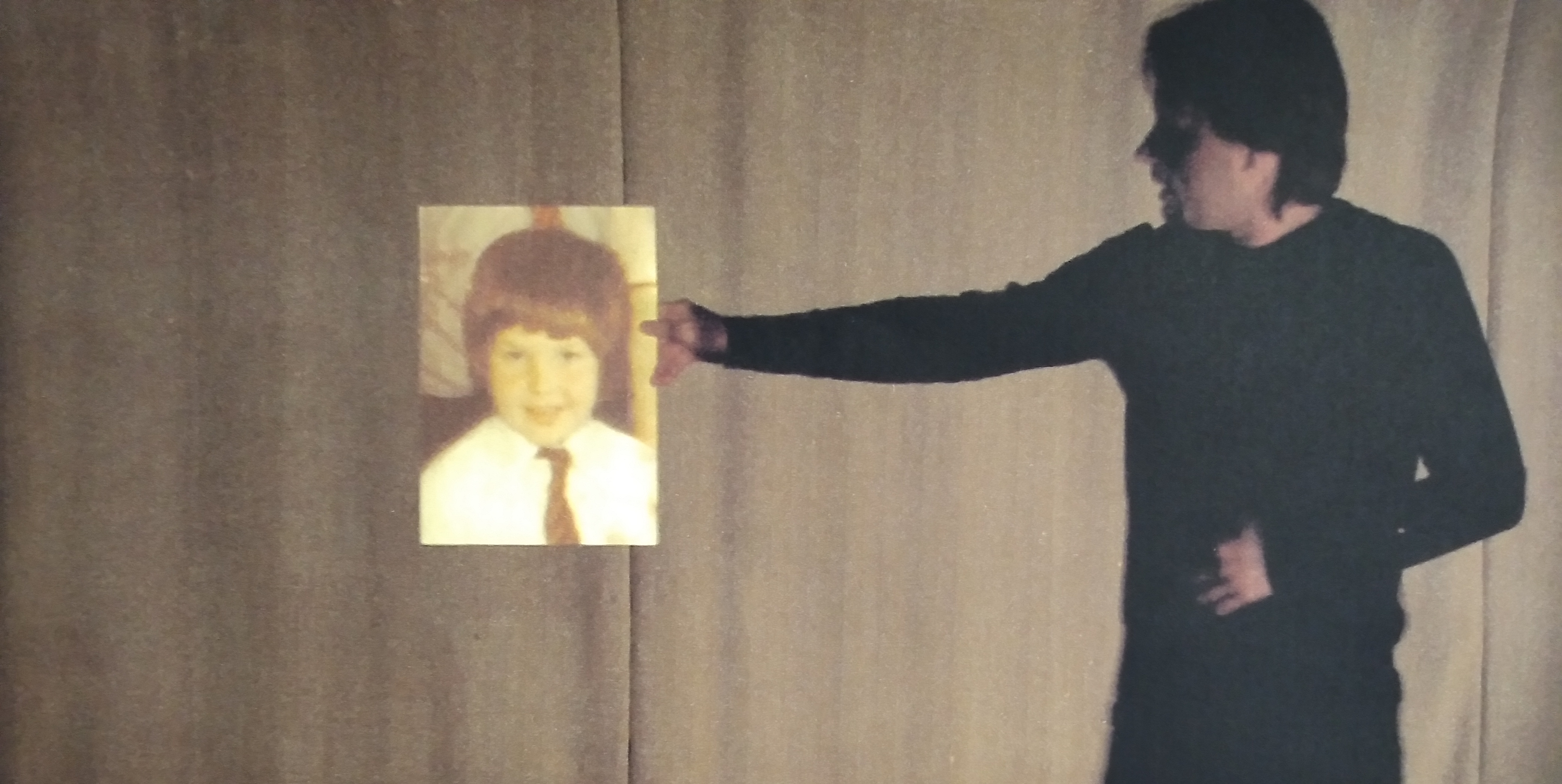
Bethany Wells performing in The Desire Paths: Sheffield. Photo by Joseph Priestley.
We are looking for performers or artists who know Bedford to be part of our team for The Desire Paths from 2nd - 5th September. The Desire Paths is a conversational, durational performance that involves drawing a street map on the floor with chalk, talking to the public and inviting them to rename a street after a hope or dream for the future. It also involves listening to any stories they tell you about themselves and/or the town, and maybe telling those stories back at the end of the project.
In Bedford we are working in partnership with The Place to present the performance in Church Square [sometimes known as Pigeon Square] so it will be an outdoor version, right in the town centre by the bus station. As visiting artists Third Angel will do some research into the history of the street names in Bedford, but we know from experience that it helps to have some people on the team who already know the streets and areas of town.
We are looking for up to 4 performers interested and/or experienced in engaging with the public, gathering stories (so listening and telling), drawing/writing in performance. You might be an actor interested in exploring more task based performance, a visual artist interested in installation and performance, a performance artist, or anything in between.
It’s 3 - 4 days work: one prep day, then two days performing, the final day will open the space up to passersby, and encourage them to use the chalk to draw their own pictures/maps/memories on the ground - probably 6 hours a day plus breaks! We can pay £120/day for freelance performers, with per diems for food and drink on top. If you’re interested, we would love to meet up and have a chat.
If this sounds like something you’d be interested in joining there is an initial meeting with The Place Bedford and Third Angel teams on Thursday 8th of July - exact times/location TBC (expected between 11am-6pm depending on availability). We will be running a site visit in the town centre, talking to interested performers and finalising the plans for the event in September. If you’re interested in joining us please get in touch directly: al@theplacebedford.org.uk, or reach out to The Place team on Social Media.
After almost a year of planning and making we are delighted that this week audiences are finally getting to play The Distraction Agents, our brand new show / experience set in the ‘world’ of our theatre show, The Department of Distractions. The Distraction Agents is a new virtual experience with real world challenges which can be enjoyed from home: part puzzle, part film, part game, part theatre, part real life. If you’re interested in playing, all the booking info is here.
Thematically and formally, The Distraction Agents draws on a number of our enduring interests, plus also more recent concerns and fascinations. Helen, our new Digital Marketing Officer, asked if we could articulate some of those inspirations in a blogpost. Hopefully this will serve as something like a programme note, giving a flavour of our research and aims, without giving any spoilers…
Can theatre shows have sequels? This thought certainly came up in rehearsal for The Department of Distractions, and also led to a discussion at a Third Angel Board Meeting at some point. Of all of our projects, The Department is the one that most obviously references genre fiction and TV drama, making several nods to the idea of a series – either of episodes or books (as we have noted before).
Both The Wooster Group and Forced Entertainment have created thematically linked trilogies of shows in the past, and writer/performer Joe Bone had great success with the movie-inspired Bane trilogy, which we caught two parts of at Cena Brasil in 2014. And then there’s Shakespeare’s histories, and two-parters like Nicholas Nickleby and Harry Potter… but none of these are the sort of sequel that we were thinking about.
The world of The Department Of Distractions seems so rich to us, that even before the tour was cut short by the pandemic, we were thinking about other stories to tell and games to play with it. We’d fallen in love with the characters a little bit, too, and didn’t want to say goodbye to them yet.
So it’s more accurate to think of The Distraction Agents as a companion piece to The Department of Distractions. Narratively, TDA it is set *after* TDOD, and features some of the same characters, but you don’t need to have seen the theatre show to play the new project – it’s a stand-alone project.
As an aside, we also wanted to create a new project in collaboration with the brilliant touring team of The Department: Umar Butt, Nick Chambers, Stacey Sampson and Louise Gregory. The pandemic has hit the arts hard, as you are no doubt aware, and it has hit freelancers the hardest. We specifically wanted to create work for as wide a group as we could afford to. We don’t know yet if or whenThe Department of Distractions will be able to tour again, so this was important to us.
Easter Eggs (and Red Herrings) The Department of Distractions knowingly plays with some of the tropes of detective fiction, such as red herrings & Easter eggs, as a stylistic and thematic devices. In the making process we half-seriously set ourselves the challenge of including a reference to every other Third Angel show, as well as films, TV shows, comics and song lyrics, amongst other things. Inevitably, this burying of clues has continued with The Distraction Agents. There are references to the original theatre show itself, as well as nods to other ideas, sources and inspirations.
Games & Puzzles Both Third Angel artistic directors, Rachael and Alex, love games and puzzles. And, as we noted in Popcorn, both of us can be quite competitive. We use gaming mechanics in a lot of our devising processes. Warm up games are common in theatre rehearsal rooms, of course, and we’re not alone in using games for devising material – we call them things like ‘text generating prompts’ and ‘rule-based devising-exercises’. Several shows are structured around the turn-taking mechanics of game play, too, such as Story Map(2010), Inspiration Exchange (2010) and Homo Ludens (2009).
Photo: Nina Urban
We like crosswords, logic puzzles, sudoku, the 1–5 number square thing that is next to the sudoku. With this project we wanted to create puzzles that are genuinely tricky, but funny to play and satisfying to solve. We discovered, of course, that coming up with a good puzzle is as satisfying as solving one. (Some of us were mesmerised by this solving of The Miracle Sudoku!)
Adventure Gamebooks Alex in particular has been a fan of adventure gamebooks for almost as long as he can remember. You might know them better as the brand names Choose Your Own Adventure, or Fighting Fantasy, both massively popular in the 1980s. But the brand Alex fell in love with as a kid were Tracker books. As a kid of 5 or 6 he had three: the Pirate one, the Detective one and the Space one.
What made the Tracker books different to the versions that followed was that they had a picture for each entry – sometimes including clues that were not mentioned in the text. What he loved was the idea that you were exploring a world, that there was no single set narrative, and he would play them repeatedly, trying to make sure he had explored every possible avenue of the narrative.
It’s been fascinating to see the renewed interest in adventure gamebooks since the appearance of Black Mirror’s Bandersnatch episode a couple of years ago, and then in the performance work being made under lockdown. The ‘choose your own path’ mechanism has cropped up in several making processes for us over the years, most notably Homo Ludens (with TiG7) in 2009, for which we made big maps of the narrative flowcharts of those three original Tracker books. And now we have finally been able to map an adventure gamebook first, and then write it, as part of this project.
Escape Rooms Rachael in particular enjoys a good escape room or adventure trail – either in person or, more recently, played over Zoom, as has become popular during lockdown. Something that is a challenge, but that also provides you with fun, that aims to entertain you. We were interested in making something that did this using several platforms – that provides audiences with something tangible, as well as something to watch. We asked ourselves, how do we enable people to be more active viewers of film and video work?
Playing games remotely in lockdown, we enjoyed experiences where we could co-operate, work as a team. The Distraction Agents was originally designed to be played solo, but through the process of playtesting, we realised that it could be enjoyed by a household, at the same time, or in sequence, if people want to play on their own and then pass the materials on to a friend.
Play By Mail The Distraction Agents is an experience delivered to the audience via video communications and resources sent by post. Individual audience members are recruited by The Department to go undercover in their own lives. We’ve always loved postcards, letters and puzzles sent through the post, plus mail art, zines and play-by-mail role-playing games. This idea of remote/delivered performance is something we have experimented with before (in Pleasant Land [2004] Favourite Ever Christmas Present [2010] and Cape Wrath [on Twitter in 2011] for example) and have been meaning to come back to for some time. Working with designer Bethany Wells it’s been a joy to create maps, booklets, instruction cards and various other ‘published objects’ (for want of a better description) to send out to players.
It’s worth noting, perhaps, at this mention of players, that the ‘game’ offers different levels of involvement and participation. Play-testers spent between 2–5 hours on the experience (usually about 3hours), through re-watching and replaying different aspects of the game. Some puzzles are necessary in order to complete the task of the show, but other activities are suggestions and invitations. You can play entirely at home, or out in the world; you can play over the five days that the instruction videos arrive, or save them up and play all in one go or at whatever pace suits you.
The complication the play-by-mail element gives us is that you need to book a week in advance of the week you want to play. We’re learning how this works as we go, and are initially doing a 4-week run (details here). Depending on how it goes we might extend that 4-week window or run the piece again in the autumn. Watch this space.
Short Film We’ve always made film work, as part of the live performance pieces, and as stand-alone shorts, and we wanted to do more of that. Performance for camera has had a new lease of life during lockdown, and watching on mobile devices has affected what constitutes a ‘short’ film.
Short film Project Zero, made from film footage shot for theatre show Experiment Zero. Image: Rob Hardy.
Over the course of making the project (in collaboration with film-maker Brett Chapman), we moved from the idea of a smaller number of 10 minute films, to a larger number of much shorter pieces. We’ve also always liked the idea that short films are a genre of their own, and they don’t have to adhere to the rules of another genre (drama, fiction, documentary or performance for camera). In these days of video messaging and live streams to/from phones, this seems even more relevant.
Oral Folklore & Storytelling We’ve long been fascinated by urban legends, but also the more verifiably true stories that get repeated about particular places: stories that make a point, and influence our opinions and behaviour. Modern day allegories and fables. All of these make appearances in The Distraction Agents, woven in to the daily puzzle / game structure.
Maps & Phoneboxes The show also contains maps and phoneboxes.
**
We’ve probably forgotten some stuff, too, so perhaps we’ll come back and update this… If you’re playing The Distractions Agents, we would of course love to hear how your experience of it has been, and also about any Easter eggs you spot…
Here’s an update from Rob Fellman, our resident researcher, who is undertaking a collaborative PhD with us and the University of Sheffield.
Show and Tell
It has been some time since my introductory post, back when I began my journey as Third Angel’s researcher-in-residence. It is fair to say that rather a lot has happened since then! I was fortunate enough to be able to spend a bit of time working in the Third Angel archive between national lockdowns. It became a little safe haven from the very present crisis in the world outside, where I could escape amongst the pages of well-worn notebooks and in the translucent spaces between glossy slides of old photographic film.
Photographic negatives from the archive
As a brief aside, I have also recently been working on a national initiative that teaches secondary school pupils about all kinds of University-level topics. My course teaches them all manner of fun things about theatre archives, documentation, and ephemera… I am biased, of course, though I prefer to use the term ‘passionate’! I have always been interested in how archives exist in-and-around the theatre, as an otherwise live medium. Together with my students we have recently been asking whether, perhaps, a performance is an archive of sorts? And equally so, is the reverse of this also true: do archives ‘perform’? (I wonder, at least, whether their ghosts do?)
An unused prop - there are loads of these
At various times during 2020 I had been writing quite extensively about Third Angel’s Class of ’76. In this show, Alex is the solo performer and Rachael the director. Third Angel guide their audience between a nostalgic reflection of Alex’s own childhood, his current practice as a theatre maker, and his research into the life stories of his fellow classmates. At other times, akin to a classroom activity of show-and-tell, Alex introduces his audience to objects from his childhood, such as a toy army soldier and a set of marbles.
Following on from my writing about Class of ’76, I set about on my adventure in the archive, simultaneously playing archaeologist-detective, sifting through dusty boxes in the hope of finding some clues (to what, I didn’t yet know). As I worked my way along the shelves I uncovered items from various versions of the show, items mentioned in the show (such as a very retro-styled CD cover for ‘find-a-friend’ software), and letters written between Alex and his former classmates.
Class of ‘76 in performance
These items began to add to my appreciation of the show, evidencing and confirming the stories Third Angel had told their audience. I realise now, from the very physical and tactile experience of the archive, that Class of ’76 is as much a performance as it is a dispersed collection of memories, images and objects that are brought (back) together to tell a story-of-stories. It also occurs to me that, on some level, memories are images; stories are memory. Objects are three-dimensional images, physical traces of the past: earthly anchors for the ghosts of memory. As I write this it dawns on me, that all of this, is what an archive is…
Some of those props from the show
I plan to keep you updated on this blog with further musings and discoveries. I look forward to sharing more of my journey with you. If you are interested in keeping a closer eye on what I am up to, you can find me on Twitter @Rob_Fellman so please do feel free to connect with me on there.
In March 2020, in the middle of the tour of The Department of Distractions, we took what at the time seemed like a difficult decision to cancel the rest of the performances for that month. Difficult because cancelling shows is the opposite of what we exist for, and The Department of Distractions feels to us like a timely show that we are really proud of, and which has been connecting strongly with audiences in each venue it has travelled to.
But it felt wrong to put our cast in the position where they were going to have to continue to travel long distances on public transport, and we felt a social responsibility not to encourage people to gather in a theatre. So we made the decision, even though we were gutted that the show would not get to meet audiences in Manchester, Edinburgh and Cambridge. We’re sorry if you were hoping to see the show in one of those cities. It’s not the same of course, but the script is available here.
Sadly we also had to cancel the last two workshops of Future Makers ’20, which had been going brilliantly at Theatre Deli and Sheffield Hallam Uni in the previous weeks. After making these decisions, though, it became clear that much of the rest of our industry was thinking along similar lines, and very quickly more seasons and tours were being cancelled or postponed.
After making these announcements, we gathered all of our free-to-watch video work together in our Film Room, to make it easier for our audiences to access. We’ve also started getting these projects captioned – we’ll be adding more soon.
Since then we have also had to cancel the remaining performances of 600 People in May and October, and cancel the next planned outings of The Desire Paths in Rotherham and Bedford this summer and autumn. We hope that many of these gigs will be rescheduled for next year. We have paused work on the next touring show for theatres, originally planned for early 2021.
We’ve been taking stock, and planning for the immediate future. Our priorities for the rest of 2020 are:
to ensure that the company survives, and is able to continue to create artistic and participation projects in the future.
to support the emotional and physical welfare of our staff and their families.
taking the opportunities for learning.
supporting freelance artists and the wider Third Angel family.
planning activity in response to the new cultural and social landscape.
As a company fortunate enough to be in Arts Council England’s National Portfolio, and eligible for the government’s furlough scheme, we will be able to survive the year. By furloughing all salaried staff, at different times, during the spring and summer, we will be able to ensure that we have the resources to employ some of our freelance team on new projects in the autumn and at the start of 2021.
After some re-working, we are very pleased to still be running Arts Award, in collaboration with Growtheatre and Stacey Sampson.
We’re heavily involved in Making Room with other Sheffield companies, with the aim of supporting the wider community of Sheffield artists and freelancers.
Over the next few months the company will be fairly quiet, with only one or two of us at work most of the time. We’ll be back ready for new projects in autumn 2020 and spring 2021, and also thinking longer term about what performance and theatre can do to help in a post-Covid-19 world.
Chris Thorpe and I have a new article in the journal Performance Research: Staging The Wreckage. It’s a lovely volume, and includes contributions from friends and colleagues including Rhiannon Jones, Michael Pinchbeck and Bridget Escolme. Edited by Gianna Bouchard and Patrick Duggan, the volume explores ways of, and reasons for, staging different forms of wreckage.
As soon as I saw the call for contributions, I knew I wanted to submit something about Parts For Machines That Do Things, our 2008 show about air-crash investigation.
Chris and I had an email conversation about the fragmentary making process of the show, and then I assembled the six pages as a collage of model plane parts, our email conversation and extracts of Chris’ text for the show. The final version is published as “A Piece Of Metal: Parts Of Third Angel’s Parts For Machines That Do Things”. I’m really pleased with how it’s turned out.
In making the pages we generated more material than we had space for, of course. Here are a couple of extra images that I liked that we didn’t use, along with a brief extract from mine and Chris’ email correspondence.
ALEX: I remember that we just talked a lot to start with. We made a long list of things that the show was about.
CHRIS: I remember I used to be terrified of flying. And then I read a book about air-crash investigation. And it cured me. I remember the terror switched to awe at the complexity of the planes and the global systems that operated them.
CHRIS: We knew the thing we were re/constructing was a show, but there was no original version of it (that had smashed into the ground, or landed on water, or suddenly and violently depressurised) to work towards. And we could always make new wreckage to fill any holes that appeared.
ALEX: After a week in our studio in Sheffield, we did a couple of work-in-progress showings with BAC, in Edinburgh and London. Each time we presented a different selection and order, picking a different route through our constructed debris.
Big thanks to Gianna and Patrick for commissioning the piece.
This is the second time I’ve run an Inspiration Exchange in The SHED. The first time was in Derby in the summer. We had the Shed in its open configuration – as much outside as inside. Today, it’s autumn-almost-winter. The Shed is in its fully closed set-up and we have heaters inside. It is cosy in the afternoon, when we usually have five or six people in at any one time. For The Story of the Day summing up performance at the end of the day, there are at least 25 of us squeezed in around the table. Many of the people who shared a story have come back, and everyone else is a delegate at the InDialogue symposium which the Exchange is part of.
Once everyone is inside, we close the door and I welcome them all to the Exchange. And then I say something like this.
**
Before we start, I am thinking about coincidence.
This is a themed Inspiration Exchange. The Exchange has shifted shape many times over the last nine years: multiple artist/storytellers, a ‘closed-loop’ group of artists, even some phone / email exchanges in advance or as a follow up. But usually the format is this, me and a set of story cards.
My rule is that in each starting line-up there is at least one story given to me from every other iteration of these ‘solo’ Exchanges. But I have not done a themed version before. My good friend and sometime collaborator Hannah Nicklin did adapt the format for her own themed version of the Exchange, Games We Have Known And Loved, which I was really happy about (you can get Hannah’s Zine of it here.) But I’ve never done it myself before.
Today’s theme is Site Place and Location. So I have been back through the list of stories, all of the stories that have even been in the exchange and selected the ones that related to place in some way. Sometimes place is really significant, in others it is a more tangential element.
But in looking for stories of Place, something I notice is that the Exchange does like coincidence. In our recent show The Department of Distractions, Lockhart, the boss, says to new recruit, Daphne:
People love coincidences don’t they? They love to tell each other about them. They think they are clues. That they are evidence of something else. That they have meaning.
And so before we start, I’m thinking about that. About coincidence, about serendipity, about cause and effect. The right place at the right time. I am wondering, as I’ve already noticed it, if this will turn out to be another theme of the day.
I have prepared 28 story cards, but as you can see, only 24 cards fit on the table. This happens sometimes – changing the ratio of the grid means one or two cards don’t make it. I always feel bad for the stories on the table that don’t get chosen. But what of the story titles written but then left unused on the subs’ bench?
I leave HOW THE CHURCH BELLS WORK SEAGLASS TEN POUND POM and GOTCHA off the table.
As it turns out, coincidence is not one of the themes that emerges particularly strongly. This is an Exchange that features phone boxes, love stories, the iconic versions of countries we know, particularly America and Scotland, and people, and the good things that they can do.
I swap 01369 870 212 for TEENAGE LOVE Both of these are phonebox stories. In Teenage Love phoneboxes are windows to memories of travel, and love stories, even if they (phonebooks) do frequently smell of urine. In one scene that is particularly romantic to this UK audience, our storyteller arrives off the bus in Times Square (in the 1980s, I think) and has to find a phinebox to let her boyfriend know she has arrived in New York so he can come meet her.
However. Here’s a thing.
01369 870 212, the title of the starting story, is the phone number of this phonebox:
But I was back there this summer to find that the phone has been removed. It feels like the story title should be the number of a working phonebox, so on the way in to the Exchange this morning I found a new phonebox and prepared an extra card, 0115 950 6369. Which is the phone number of this phonebox on Lower Pavement in Nottingham:
I swapped DESIRE PATHS For DESIRE BEFORE MOBILE PHONES In which our narrator, a photographer, makes her own desire line across a crowded night club to ask her friend to introduce her to a beautiful guy she has had her eye on for a while. They make a date to meet up, choosing a field they both know, out of town. On the day, neither of them can find each other, and because they don’t have mobile phones yet, they cannot call to say where are you…?
I swapped THE WILD CEILIDH For DOWN AND OUT IN EMBANKMENT Another love story set in the days before mobile phones, and featuring lovers meeting at transport hubs, and one of them doing a chimpanzee impression on top of a phone box, and this is the moment they fall in love. Later a phonebox has to be found in order to call 999 for an ambulance, because of food poisoning so bad the husband cannot stand up.
I swapped “I’M GOING ANYWAY!” For THEY LOOK LIKE UMBRELLAS A story for her dad, because he rarely goes out, and does not get to tell people about this, but it is important to him. So our narrator chooses to tell this story for him.
Her dad likes fishing for pike. Not to kill or eat. He throws them back. He finds it relaxing. But what he has noticed over the last few years is that the population of pikes is decreasing, and the population of cormorants is growing, as their migration patterns change. People notice that there are more cormorants around, and they like it, but they don’t see the effect that has on the pike population. People should know, so his daughter is telling us.
“What does a cormorant look like?” someone asks.
“They look like umbrellas.”
I swap FOR THE LOVE OF SCAFFOLDING For SKEG IS NOW A PLACE FOR US People have put things done or said by other people into the Exchange before, but this is the first time, I think, that someone has specifically put another person in to the Exchange as the specific Inspiration.
The story to explain why this person is being put into the Exchange is the story of a proposal. A planned trip to the seaside, to look at the sea and recharge, which covers another plan for a marriage proposal in a message in a bottle, washed up on the beach at just the right time.
This secret plan is almost sabotaged by the person who is meant to be finding the bottle becoming distracted by picking up litter that is going to get washed out to sea. The telling of this bit of the story involves the word ‘Wombling’.
**
In my retelling of the story in the packed Shed my use of the word Wombling prompts a conversation about regional specificity in language, cultural memory, story-telling and, obviously, Wombles, which then becomes a thread woven into the rest of the Exchange.
After this entirely appropriate distraction of the Wombling…
**
…and after the proposal has been found and accepted and mini bottles of prosecco have been produced from pockets and uncorked, the two fiancés sit looking happily out to sea.
“You do realise…” begins the proposee, “that this means that Skeg(ness) is now A Place for us?”
I swap BARBERS CHANGE LIVES Which is one of the amazing coincidence stories that I had noted earlier For TUNNOCKS A story of a caving expedition, sponsored by Tunnocks, who now get to sponsor the story.
**
Cue more discussion about the cultural specificity of ‘Tunnocks’ and whether this translates to an international audience, and whether the wafers or teacakes are better, and do they really only make two things?
**
And this is also, another story that puts a person into the Exchange.
A sixteen hour caving expedition, visiting previously unmapped caves. A moment to think about the fact that humans had not been in these caves for hundreds of thousands of years – if ever. Twelve hours in, a friend is starting to struggle. By some people’s standards he is not ‘fit enough’ to undertake this challenge.
Back on the surface and one of the cavers is vocal in his criticisms and insults about the ill friend – slowing them down, putting himself at risk. And then the realisation. Listening to this tirade, our narrator is struck by “the dramatic contrast between what you are hearing and what you are knowing.” He knows that the angry caver is wrong. What the friend deserves is admiration and respect. Our narrator understands some of the challenges his friend faces, and that he will not be deterred. Whatever the challenges other people set for themselves, “it might take him longer, but he will still do it.”
I swap TAKE MY CAR For HESITATION A story of unexpected kindness and consideration from a stranger. The slip-road shunt is your fault, and will cost the other driver far more money. But instead of shouting at you through the window, as you are expecting, his main concern is that you are okay.
I swap EMPTY BENCHES For THE SHOES A story from a friend. A story about how we can’t always know the whole story. We can’t always know what happens next. A story about generosity and kindness. About how we can’t always know whether our acts of kindness will have a lasting effect. How we can’t always know our own motives for those acts of kindness. But how, in the end, the important thing is that we do them.
Finally, I was warned in advance that I might not get a story back, but I still told “YOU’RE GOING THE WRONG WAY!” “I KNOW!” And in keeping with the spirit of that story, I didn’t get a story back. Which meant that at the end of the day the table looked like this.
**
Huddled into The Shed for company and warmth, no one moves to leave. Conversation returns to stories and Wombles.
This month, which marks the 24th anniversary of our first performance, Testcard, we are delighted to be publishing There’s A Room: Three Performance Texts by Third Angel with the brilliant folk at Oberon Books.
Early on in our career we talked more about writing down than about writing. The durational and installation works were represented as lists of instructions – if they were written down at all. Texts for the theatre pieces were assembled from improvisations, transcriptions of film dialogue found texts and conversations with audiences. We didn’t really think of them as scripts, or about other people performing them.
That probably changed with Where From Here, which we made with Jerry Killick in 2000. We’ve talked in the past about this show being a ‘coming of age’ show for Third Angel, and certainly it toured more extensively than anything we had made before. Several times in the touring life of the show Alex stepped in for Jerry when he wasn’t available. Even though the show was made and presented using a substantial amount of autobiographical improvisation, we found that Alex borrowed most of Jerry’s material and only added his own material in the final scene. At some point there was a conversation about other people performing it, and after the touring was finished, Rachael and Jerry wrote down their improvised sections (the rooms and the stories in them, if you know the show) and we added in the written speeches and made a script. There were a couple of conversations about publishing it, but it never quite happened.
Since then writing has become a more deliberate aspect of our process, and even in the more devised shows, printed scripts/texts are created for dramaturgical and technical purposes – for cueing the shows and for surtitling international gigs.
From the Introduction: There’s A Room
“Who’s in the room?” This is the question we ask ourselves about each project. It means, who is making this show? Who is in the room in which the work is getting made? Whose voices, whose expertise, whose experience is being brought together to tell this story with us?
When we started talking to Oberon about publishing some of the shows, a couple of years ago, we realised that a ‘complete works’ volume was not financially viable, and that we had to make a first choice of what we want to publish in this collection. We were interested in collecting shows that were created through exploratory, collaborative devising processes, and had resulted in scripts that could be performed by other artists and companies. With that in mind it was clear that the other two texts should bePresumption, made with Chris Thorpe, and What I Heard About the World, made with Chris and our Portuguese friends at mala voadora. These are the shows that have either been performed by another company (Presumption, The ECC, Brussels, 2012/13) or people have asked about the performance rights.
So we’ve gone back to the touring scripts, updated whilst on the road as the shows evolved, and added in some stage directions on top of the Stage Management notes, expanded some of our performer short-hand to make a few things clearer. We’ve written new introductory essays to explain the devising process of each show, and some more background about the company. We’re looking forward to it being out in the world.
The title of this collection also refers to the situation of each show, and the concerns of the work. Each takes place in a particular room – in which the audience are acknowledged to a greater or lesser extent. In each piece the lives of the people in the room together are affected by events in the world beyond its walls. Events they have taken part in, events they have heard about, events they have imagined. Taken chronologically, the three shows turn their attention outward, from the intensity of personal relationships and our domestic lives, to the overwhelming number of stories and events taking place in the world beyond.
We’re launching the book on 14th October 2019 at the Off The Shelf Festival in Sheffield, at 7pm, at Sheffield Hallam University’s Performance Lab on Arundel Gate. Rachael and Alex will be in conversation with writer and critic Lyn Gardner*, and we’ll be reading a few selections from each show. We’d love you to join us – tickets are available here.
Thanks to everyone at Oberon for pulling this together. Cover design above by Konstantinos Vasdekis. Photograph of Rachael Walton in Where From Here by Rob Hardy. Publication supported by Leeds Beckett University.
*Update: we’re sorry to learn that Lyn has had to clear her diary to deal with a family emergency. Chris Thorpe was scheduled to be with us for the event anyway, and will now help lead discussions. We wish Lyn the very best and thank Chris for stepping up.
We are delighted to be able to announce the artists and companies we will be mentoring through this year’s BOOST Your Artistic Practice scheme, in collaboration with Sheffield Theatres.
As ever, it was incredibly difficult to choose which artists and projects to select, and we could have happily supported far more than the four we have chosen. Thank you to everyone who applied - it is inspiring to hear about so many exciting projects in development.
We’re really excited to start working with this year’s Mentees:
we will work with gobscure to develop their new show provoked to madness by the brutality of wealth weaving live-art and text-art into playful creative resistances that are urgent, but will also hope to offer a hard-won hopefulness, too.
Emergency Chorus
Emergency Chorus. Photo: The Other Richard.
We will support Emergency Chorus to play, experiment and generate material towards their new show, Something in Your Voice, working with an expanded group of deviser performers.
The Six Twenty
The Six Twenty: BUSY
The endless hurrying between meetings. Racing for trains. Not enough time for lunch. And somehow getting the kids out the door with only seconds to spare… The Six Twenty will spend a week with us exploring why we are all so BUSY for their new immersive and interactive show.
Tommi Bryson
Tommi Bryson performing at Queer Scratch Night at The Cellar Theatre (photo courtesy of The Cellar theatre)
We will work with performer and composer Tommi Bryson to develop a full length version of her solo, Disney-inspired musical, A Princess Could Work.
Big thanks to Sheffield Theatres for supporting the scheme and to Umar Butt and Ruby Clarke for their help with the very difficult task of selecting these exciting artists and companies. We’ll be working with them in the Crucible and Lyceum Theatre Rehearsal Rooms between September 2019 and February 2020. We’re really looking forward to getting started.